
Announcement, Press Release |
CHICAGO — The Office of the Chief Judge of the Circuit Court of Cook County today released comprehensive data on its Electronic Monitoring (EM) program, including current non-compliance figures and warrant status. The release reflects Chief Judge Charles S. Beach II’s commitment to transparency and public accountability in the administration of the EM program.
“Transparency is not optional — it is a core obligation of this office. The public has a right to know how this program operates, what the data shows and what we are doing every day to make it stronger,” states Chief Judge Charles Beach II, Circuit Court of Cook County. “We are releasing this information because that is what accountability looks like.”
The Office of the Chief Judge of the Circuit Court of Cook County assumed responsibility for all new electronic monitoring participants on April 1, 2025, following the Cook County Sheriff’s transition out of the program. Since that time, the Office of the Chief Judge has worked to modernize and strengthen the program’s oversight infrastructure, including updated response protocols announced on Jan. 28, 2026.
"The Criminal Division is fully committed to ensuring that electronic monitoring violations are brought before a judge promptly and that our judicial review process operates with the rigor and consistency the public deserves,” said Judge Erica L. Reddick, Deputy Chief Judge, Criminal Division, Circuit Court of Cook County. “The updated protocols put in place in January reflect that commitment — and our work to strengthen how violations are identified, reported and adjudicated is ongoing. We will not stop improving this system."
The weekly EM demographic reports, including enrollment data and zone compliance summaries, are publicly available on the court’s website, here. The most recent report reflects data through May 1.
Non-compliance violations in the EM program fall into two primary categories. The most common is device-related: individuals whose monitoring equipment has low battery alarms. The second involves individuals who leave or arrive late to their approved location.
In all major violation scenarios, the following process applies:
- The assigned Adult Probation staff is notified and reviews circumstances to determine if the alert reflects a major violation, a device or emergency issue
- If valid, a major violation report is filed and submitted to court no later than the following business day for judicial review
- A judge determines next steps: continuance, additional conditions or issuance of a warrant
- Where a warrant is issued, the warrant is entered into the law enforcement LEADS system and the Cook County Sheriff’s Office is notified
- Law enforcement is responsible for the execution of the warrant and return of the defendant to custody until the case is brought back to court
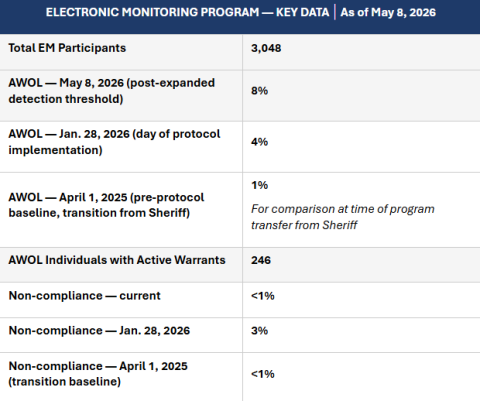
“AWOL” (Absent Without Leave) refers to circumstances in which a participant assigned to electronic monitoring is determined to be outside of their approved inclusion zone or residence during required curfew hours, or when the electronic monitoring device is no longer communicating with the monitoring system.
An AWOL status may include situations where:
- the participant has been outside of the home inclusion zone during curfew for three or more hours on weekdays or weekends;
- the device battery has become depleted; or
- the monitoring device has otherwise lost communication or connectivity.
The comparison of AWOL percentages across the three time points in the table above requires important context. Prior to Jan. 28, 2026, an absence of fewer than 48 hours did not constitute a major violation and was not captured in AWOL reporting. Judicial review of violations also occurred only on weekdays, meaning weekend violations were subject to delayed action. The updated protocols lowered the violation threshold to three or more hours and extended judicial review to weekends for the first time.
The result is a more sensitive and responsive detection system — one that identifies and acts on violations that previously would not have been captured at all. Monitoring data from the court’s electronic monitoring vendor reflects no corresponding increase in overall alarm volume during this period, supporting the conclusion that the increase in reported AWOL figures reflects improved detection, not increased violations.
The Office of the Chief Judge is continuing a comprehensive review of its Electronic Monitoring systems, processes and protocols to identify opportunities for improvement and ensure consistent implementation across all cases. That review reflects Chief Judge Beach's commitment to building an EM program that is not only responsive to violations but continuously strengthened by data, accountability and cross-agency coordination — including strengthened coordination with the Cook County Sheriff's Office on warrant execution timelines and communication protocols.
Few court systems in Illinois or nationally publish this level of operational detail on electronic monitoring programs. The Office of the Chief Judge is committed to changing that — beginning with this release and the regular public reporting that will follow starting May 26.
Media Contact: ocj.press@cookcountyil.gov
(312) 603-5414
Follow the court on:
X @CookCntyCourt
Facebook @Circuit Court of Cook County